Key Takeaways
- Cushioning reduces joint impact but must stay stable, especially for knees and ankles during long or frequent runs.
- Nike uses multiple cushioning systems (React, ZoomX, Air, Cushlon) to balance shock absorption and energy return for different running needs.
- Stack height and heel-to-toe drop matter for joint protection, particularly for runners with knee pain or calf sensitivity.
- Stability and fit are as important as softness, since unstable cushioning can increase joint strain over time.
- Nike offers cushioned options for every runner type, including daily trainers, marathon shoes, speed trainers, and stability-focused models.
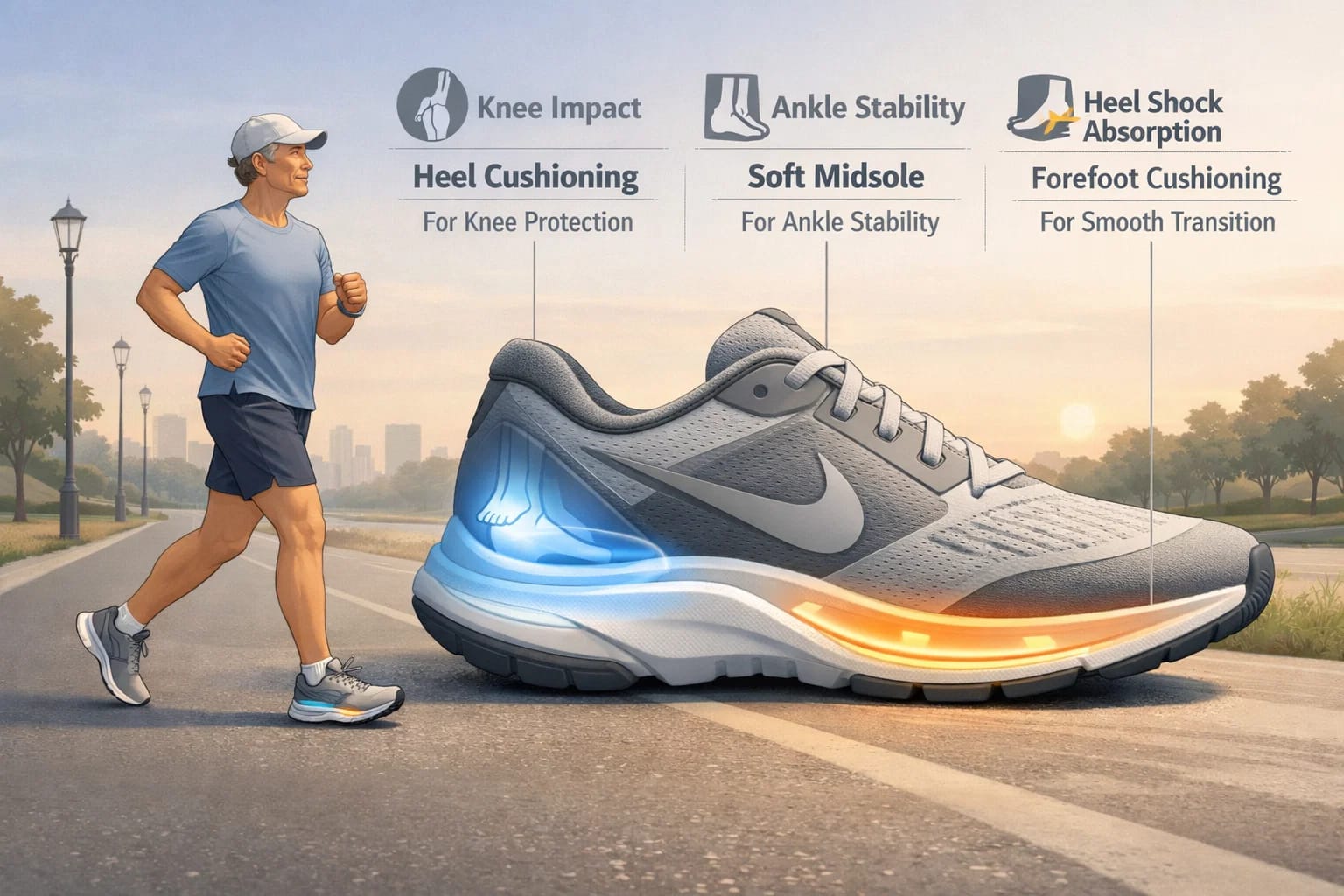
Best Nike running shoes for cushioning and joint protection are models with a soft, impact-absorbing midsole, stable geometry, and a secure upper that reduces harsh landing forces on knees, ankles, and hips https://www.nike.com/ro/w/womens-running-shoes-37v7jz5e1x6zy7ok. Nike does this with foams like Nike React and Nike ZoomX, plus designs that create a smoother heel-to-toe transition and better shock diffusion.
This guide covers where cushioning works best, what to look for (stack height, drop, weight, shock absorption, energy return, arch support), how to pick the right shoe by run type and surface, and a full list of top cushioned picks and shoe models.
Top Picks
- Best Overall (Nike): Nike Vomero 18 for plush daily cushioning and long-run comfort
- Best Daily Trainer (Nike): Nike Pegasus 41 for balanced cushioning and reliable mileage
- Best Shock Absorption (Nike): Nike Invincible 3 for soft landings and joint comfort
- Best Stability Cushioning (Nike): Nike Structure 26 for cushioned support when form breaks down
- Best Road-to-Trail Cushioning (Nike): Nike Pegasus Trail 5 GORE-TEX for wet weather and mixed routes
- Best Speed Cushioning (Nike): Nike Zoom Fly 6 for faster days with a cushioned feel
- Best Racing Cushioning (Nike): Nike Alphafly 3 for maximum performance cushioning on race day
The Importance of Cushioned Shoes
Cushioned running shoes reduce peak impact and spread pressure across the foot. That matters most when joints already feel stressed, mileage is rising, or recovery is limited. Cushioning does not fix every pain issue, but cushioning can make running feel smoother and less punishing.
Where Cushioning Works Best
Cushioning works best in these cases:
- Road running on hard surfaces where impact repeats
- Long distances where small discomfort becomes big discomfort
- High-frequency training (4–7 days/week) where legs rarely feel fresh
- Recovery runs where you want reduced muscle fatigue
- Heavier runners who feel impact more strongly
- Cold weather running where legs feel stiff at first
What to Consider When Choosing Cushioned Running Shoes
Stack Height: Max-Cushioned or Minimalist?
Stack height is the midsole height under the heel and forefoot.
- Max-cushioned shoes can feel protective and calm underfoot.
- Lower stack shoes can feel more stable and controlled for some runners.
Pick the stack height based on how stable you feel at easy pace, not based on what looks “fast.”
Cushioning Material
Foam and air units change how cushioning feels. Soft foam can feel protective. Firmer foam can feel stable. Some foams feel bouncy. Some foams feel muted.
Nike options include Nike React, Nike ZoomX, Nike Cushlon, and Nike Zoom Air, plus Nike Air units in some builds.
Weight
Lower weight can feel easier on longer runs, but weight should not beat comfort. Beginners and casual runners usually do better with a slightly heavier shoe that feels steady and secure.
Heel-to-Toe Drop: Mind Your Strike Pattern
Heel-to-toe drop is the height difference between heel and forefoot.
- Higher drop can feel easier on calves and Achilles for some runners.
- Lower drop can feel more natural for midfoot runners but can stress calves if you switch too fast.
If you want a lower-drop feel, transition gradually.
Shock Absorption and Midsole Softness
Shock absorption is the “impact shield” effect. A softer midsole can reduce harsh landings, but too soft can feel unstable if you overpronate or run on uneven surfaces.
Energy Return
Energy return is how much the shoe gives back during toe-off. More rebound can feel efficient. Too much bounce can feel uncontrolled for some runners.
Arch Support
Arch support can come from geometry, midsole sidewalls, and stable platforms. True “support” is usually more about stability than about pushing the arch up.
- Neutral arches often do best with neutral cushioned shoes
- Flat arches often do best with cushioned stability shoes
- High arches often do best with cushioned shoes that do not feel harsh
How to Pick the Best Running Shoes
Types of Running Shoes
Men’s Shoes
Men’s models often run wider in the forefoot and can feel firmer at the same labeled size. Do not assume that a men’s shoe is “more supportive.” Pick by fit and stability.
Women’s Shoes
Women’s models often run narrower in the heel and can feel softer at the same labeled size. The best choice still comes down to fit and comfort.
The Importance of Fit
A cushioned shoe that fits poorly can still hurt joints. Check:
- Heel lockdown (no sliding)
- Toe room (no toe bang)
- Midfoot security (no side-to-side roll)
Where Will You Run?
- Road running: pick smoother outsoles and stable cushioning
- Mixed surfaces: pick versatile tread and secure uppers
- Wet weather: consider traction and water management, not just GoreTex
How Far and How Often?
- Short runs (2–5 km / 1–3 mi): moderate cushioning works
- Medium runs (5–15 km / 3–9 mi): balanced cushioning helps
- Long runs (15+ km / 9+ mi): plush cushioning and stable geometry matter
Shoe Design Considerations
Look for:
- Stable base width
- Sidewalls that guide the foot
- Smooth rocker if you want easy transitions
- Breathable upper that holds shape
Road or Trail?
If you run trails sometimes, use a trail shoe for traction and foot protection. For cushioned trail picks, models like Hoka Speedgoat 6, Nike Ultrafly, Nike Kiger 10, and Altra Timp 5 fit the “protect the legs” goal.
Features in Running Shoes
Nike FlyEase
Nike FlyEase is a closure system designed for easier on/off. It helps runners who want quick entry, limited mobility support, or simpler daily use.
Reflective Elements
Reflective elements matter for early morning or night running. This is a real safety feature, not a style detail.
How We Selected / How We Test
We select cushioned shoes based on:
- Cushion feel at easy pace and steady pace
- Perceived impact absorption (heel and forefoot)
- Stability during fatigue
- Fit security and upper hold
- Versatility across distances
- Value at typical pricing
We test by using the same runner on the same routes: flat roads, rough pavement, and mild turns. We also include treadmill miles for consistency and outdoor miles for real impact.
Best Cushioned Running Shoes
Best Overall
Nike Vomero 18 for plush cushioning with an easy, protective ride.
Best Daily Trainer
Nike Pegasus 41 for balanced cushioning, steady mileage, and broad usability.
Best for Long Distances
Asics Gel-Nimbus 28 for long-run comfort and consistent cushioning.
Best for Casual Runners
Nike Winflo 11 for simple comfort at a friendlier budget.
Best for Neutral Arches
Brooks Ghost 17 for stable neutral cushioning and predictable transitions.
Best for Flat Arches
Nike Structure 26 for cushioned stability and guidance when overpronation shows up late in a run.
Best for High Arches
New Balance 1080v15 for soft comfort without feeling harsh.
Best Speed Shoe
Saucony Endorphin Speed 5 for faster days with a cushioned, responsive feel.
Best Wide Toe Box
Altra Torin 8 for toe room and comfort-focused miles.
Best Maximum Cushioning
Brooks Glycerin Max for a high-comfort, high-cushion experience.
Editor’s Pick
Nike Invincible 3 for soft landings and strong joint protection on easy days.
Best Zero Drop
Altra Escalante 4 for a zero-drop feel that still works for daily running.
Best Value Cushioned Shoes
Under Armour Sonic 7 for budget-friendly comfort and daily use.
Most Versatile Cushioned Running Shoes
Saucony Ride 19 for steady training across a wide range of paces.
Best Cushioned Running Shoes For Stability
Brooks Glycerin GTS 23 for cushioned support that does not feel stiff.
Best Nike Running Shoes Overall
Nike Pegasus 41 for the broadest “one shoe” use case.
Nike Running Shoes With The Best Energy Return
Nike Alphafly 3 for high-level performance cushioning and race-day pop.
Best Nike Running Shoes For Marathon
Nike Alphafly 3 for marathon racing, Nike Vomero 18 for marathon training comfort.
Best Nike Running Shoes For 5K/10K Races
Nike Zoom Fly 6 for a faster, cushioned road feel.
Nike Road Running Shoes With The Best Stability
Nike Structure 26 for guidance and control with cushioning.
Nike Running Shoes With The Best Shock Absorption
Nike Invincible 3 for maximum softness and impact attenuation.
Best Nike Supertrainer For Daily Running
Nike Vomero Plus as a “plush daily miles” option when you want comfort-first training.
Best Overall Road Running Shoe
Asics Novablast 5 for a bouncy, fun daily trainer feel.
Best Overall Trail Running Shoe
Hoka Speedgoat 6 for grip plus cushion on rougher trails.
Best Road Racing Shoe
Adidas Adizero Pro 4 for top-end road racing speed.
Best Trail Racing Shoe
Hoka Tecton X 3 for high-performance trail racing cushioning.
Best Stability Running Shoe
Saucony Hurricane 25 for support-focused daily running.
Best Budget Running Shoe
Nike Winflo 11 for entry pricing with real cushioning.
Shoe Models
Brooks Glycerin Max
High cushion comfort built for easy runs and long runs.
Under Armour Sonic 7
Value-oriented daily trainer with simple cushioning.
Altra Fwd Via 2
Forward-feel geometry with an Altra-style fit approach.
Saucony Guide 18
Daily stability trainer with a guided, cushioned ride.
Nike Vomero 18
Plush Nike road shoe focused on cushioning and joint comfort.
Altra Timp 5
Trail cushioning with Altra-style fit and foot room.
Topo Athletic Aura
Comfort-first platform with a stable, protective feel.
Hoka Speedgoat 6
Cushioned trail shoe built for grip and protection https://www.hoka.com/en/us/.
Nike Men’s InfinityRN 4 Road Running Shoes
Cushioned stability feel aimed at steady training and protection.
Nike Pegasus 41
Balanced daily trainer for most runners.
Nike Invincible 3
Soft, protective cushioning built for impact reduction.
Nike Pegasus Trail 5 GORE-TEX
Road-to-trail cushioning with wet-weather coverage.
Nike Structure 26
Cushioned stability shoe that guides stride when tired.
Nike Free Metcon 6 Men’s Workout Shoes
Training shoe for gym and cross-training, not long road runs.
Nike Vomero 17 Women’s Road Running Shoes
Plush road shoe option with a comfort-first focus.
New Balance 1080v15
Soft daily comfort with a smooth ride.
Saucony Ride 19
All-around daily training shoe with balanced cushioning.
Brooks Ghost 17
Reliable neutral trainer with predictable comfort.
Brooks Glycerin GTS 23
Cushioned stability that feels smooth, not rigid.
Asics Gel-Nimbus 28
Long-run comfort shoe with a soft, protective feel https://www.asics.com/us/en-us/women/c/aa20000000/.
Saucony Endorphin Speed 5
Speed-focused trainer with cushion and bounce.
Hoka Gaviota 6
Max cushion stability for runners who want support.
On Cloudmonster Hyper
High-stack, lively cushion feel for daily training.
Saucony Women’s Triumph 23
Plush daily comfort with long-run readiness.
Altra Torin 8
Roomy toe box comfort with a neutral ride.
Puma Magnify Nitro 3
Soft cushion daily trainer feel with good durability.
Puma Velocity Nitro 4
Balanced cushion trainer that can handle faster work.
Asics Novablast 5
Springy daily trainer style for runners who like rebound.
Hoka Arahi 8
Light stability with a smoother ride feel.
Saucony Hurricane 25
Support-first cushioning for steady training.
Altra Escalante 4
Zero-drop, flexible daily trainer with toe room.
Nike Winflo 11
Affordable Nike option with everyday cushioning.
Nike Alphafly 3
Top-end Nike racing shoe with maximum performance cushioning.
Nike Ultrafly
Trail-focused performance shoe built for speed and distance.
Nike Kiger 10
Trail shoe for quicker handling and better ground feel.
Hoka Bondi 9
Max cushion road shoe built for comfort.
Brooks Ghost Max 2
Max cushion version of a stable, easy road ride.
ASICS Nimbus 27
Comfort shoe with a softer feel and long-run focus.
Mizuno Wave Sky 8
Cushioned trainer with a stable, structured feel.
On CloudSurfer Next
Smooth, rolling ride feel aimed at daily mileage.
New Balance 1080 V14
Soft comfort and steady mileage focus.
Hoka Gaviota 5
Previous-gen max cushion stability option.
Brooks Women’s Glycerin GTS 20
Stability cushioning in a comfort-first build.
Hoka Women’s Stinson 7
Big cushion feel often used for road-to-trail comfort.
Hoka Women’s Speedgoat 5 GTX Trail Runners
Water-resistant trail cushioning for wet conditions.
Kuru Men’s TRIPLE MAX Ion
Comfort-focused walking/running crossover style.
New Balance Fresh Foam X 1080v12
Older-gen soft daily cushioning option.
Hoka One One Bondi 9
Common naming variant used by retailers for Bondi 9.
Saucony Kinvara 15
Lighter daily trainer for runners who want less bulk.
Brooks Adrenaline GTS 24
Stable daily trainer with a guided, cushioned feel.
HOKA Skyward X
High-stack performance trainer concept focused on cushion and efficiency.
On Cloudboom Strike
Racing-focused model with a faster feel.
Topo Cyclone
Light, responsive trainer with a roomy forefoot style.
Hoka Challenger 7
Road-to-trail comfort shoe for mixed routes.
On Running CloudMonster 2
High cushion daily trainer with a bold underfoot feel.
Hoka Mach X2
Faster training shoe built for tempo comfort.
Nike Zoom Fly 6
Cushioned speed trainer for workouts and races.
New Balance Fresh Foam More v5
Max cushion comfort for easy miles.
New Balance FuelCell Supercomp Trainer v3
Supertrainer style shoe for fast training with cushion.
Adidas Adizero Pro 4
Road racing shoe for performance-focused runners.
Saucony Endorphin Speed 4
Previous-gen speed trainer with a snappy feel.
Nike Cushioning Technology
Nike Air
Pressurized air units designed to absorb impact and soften landings.
Nike React
Foam designed for durability and a balanced cushion feel.
Nike Joyride
Bead-based cushioning concept built for a soft, adaptive underfoot feel.
Nike ZoomX
Light, responsive foam designed for high energy return.
Nike Zoom Air
Air unit tuned for quick response and a faster feel.
Nike Cushlon
Foam used for soft, smooth daily comfort.
Nike Phylon
Light EVA-style foam used in many classic trainer builds.
Nike Shox
Column-based cushioning concept associated with impact absorption and structure.
Cushioned Running Shoes FAQ
How much cushioning do I need?
You need enough cushioning to finish runs without foot soreness or joint irritation. Beginners often do best with moderate-to-plush cushioning, then adjust based on stability and comfort.
Is it possible to have too much cushioning?
Yes. Too much softness can feel unstable, especially for overpronation or cornering. Pick cushioning that feels controlled at easy pace.
How do I know when I need a new pair of my running shoes?
Replace shoes when cushioning feels “dead,” aches appear after easy runs, or the outsole is worn unevenly.
How often should you replace your running shoes?
A common range is 300–500 miles (480–800 km), but replacement depends on body weight, surfaces, and how soft the foam is.
Can I use Nike running shoes for other activities like walking or cross-training?
Yes for walking and casual use. Cross-training is different. For gym and lateral movement, use a trainer like Nike Free Metcon 6 Men’s Workout Shoes, not a soft max-cushion runner.
Are there Nike running shoes specifically designed for wide or narrow feet?
Nike offers some models in wide sizing in certain regions and releases. Fit varies by model, so try on or buy from a retailer with easy returns.
Running Shoes for Knee Pain
How to Choose Running Shoes for Bad Knees
Midsole Cushioning or Stabilizing Features
For knee pain, pick cushioning plus stability if your stride collapses late in runs. Nike Structure 26 is the “cushioned stability” style. Nike Invincible 3 is the “soft landing” style.
Heel-Toe Drop
A moderate drop often feels easier on calves and Achilles, which can reduce compensation patterns up the chain.
Supportive Upper
A supportive upper reduces foot slide and knee twist from unstable landings.
Lightweight Construction
Lightweight helps fatigue, but stability and comfort matter more than grams.
Why Do Your Knees Hurt While Running?
Runner’s Knee
Front-of-knee pain often linked to load, cadence, and hip control.
IT Band Syndrome
Outer-knee pain often linked to training load and hip stability issues.
Patellar Tendonitis
Pain below kneecap often linked to speed work, hills, or sudden volume changes.
Knee Bursitis
Localized swelling and irritation that can flare with repeated impact.
Arthritis
Joint changes that can worsen with poor shock absorption and poor recovery.
Bad Form
Overstriding and low cadence can increase braking forces.
Overpronation or Supination
Foot mechanics can shift knee loading patterns. Stability shoes can help some runners.
Glossary of Running Shoe Terms
- Outsole: rubber bottom layer
- Midsole: foam layer that provides cushioning
- Upper: the fabric structure that holds the foot
- Stack height: midsole height under foot
- Drop: heel height minus forefoot height
- Stability: design features that reduce unwanted roll
- Rocker: curved sole shape for smoother transitions
Nike Midsole Foams
Nike commonly uses foam families like Nike React, Nike ZoomX, Nike Cushlon, plus combinations with air units.
Make sure you get the right size and fit
Pick size by toe room and lockdown. Leave a thumb-width in front of the big toe. Lock the heel. Avoid side roll.
Summer or winter? There is a Nike shoe for both
Hot climates often need breathable uppers. Wet winters can justify GoreTex. This matters across regions like United States, Canada, Latin America, Asia Pacific, Australia, Hong Kong, India, Indonesia, and in Africa including Egypt, Morocco, South Africa, plus Argentina, Brasil, Chile, Colombia, México, Peru, Puerto Rico, Uruguay where weather swings and surfaces vary.
Summary
Best Nike Running Shoes for Cushioning and Joint Protection focuses on Nike models designed to reduce impact stress on knees, ankles, and hips through effective midsole cushioning, stable geometry, and controlled energy return. The guide explains where cushioning matters most, how factors like stack height, heel-to-toe drop, foam type, and arch support affect joint comfort, and how to choose the right shoe based on distance, surface, and running frequency. It compares Nike cushioning technologies and highlights top Nike running shoes for daily training, long distances, speed work, stability needs, and joint pain prevention.