Key Takeaways
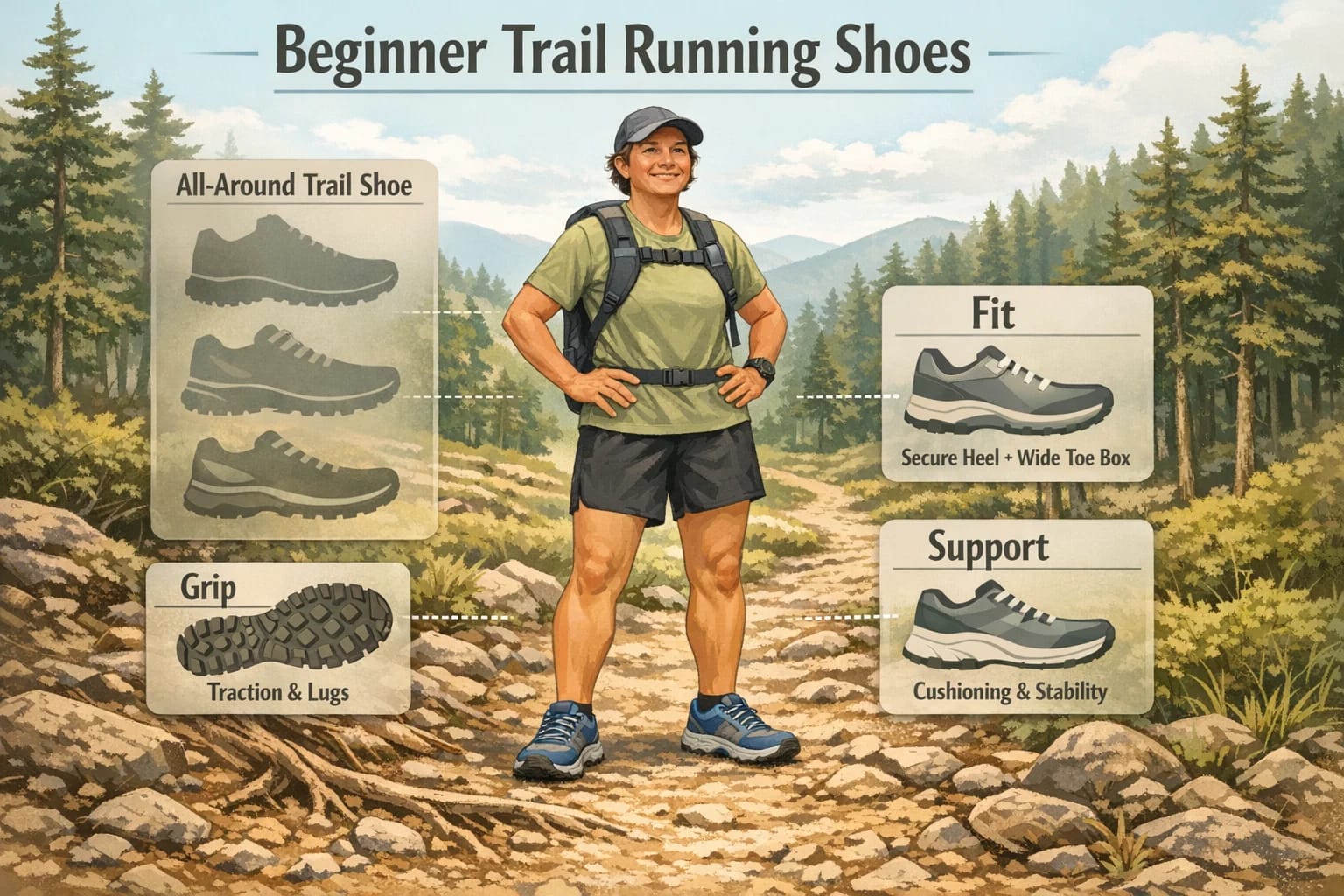
- Beginner trail running shoes should feel forgiving and stable, not fast or aggressive, with predictable grip and cushioning.
- All-around trail shoes like the Brooks Cascadia 19 or Salomon Sense Ride 5 work best for first-time runners still learning terrain and footing.
- Road-to-trail shoes are ideal for mixed surfaces, making them a strong entry option if your runs include both pavement and dirt.
- Wide toe boxes and proper drop matter for beginners, especially for comfort, swelling, and gradual adaptation to trails.
- Waterproof trail shoes are rarely necessary for beginners, since non-waterproof shoes dry faster and feel cooler on long runs.
Introduction
Best trail running shoes for beginners are trail running shoes that make early trail miles feel predictable and forgiving, with confidence-inspiring grip, a secure fit, and enough protection to reduce ankle strain and foot fatigue on mixed terrain.
The main benefits are better traction on dirt and gravel, steadier ground contact on roots and rocks, and fewer “first run” foot issues like hotspots and toe bang. The main uses are easy trail running, road-to-trail routes, muddy paths, and hiking days where you want comfort over competition. The key components are the outsole lugs and rubber, midsole cushioning, upper lockdown, toe protection, heel/forefoot stack height, and heel-to-toe drop (plus options like GoreTex).
This guide will help you find the Best Trail Running Shoes for Beginners in 2026.
Why Your Road Running Shoes Are Failing You on Trails — The Science
If you’ve tried taking your road runners onto a dirt path and ended up with muddy ankles and a bruised ego, you’re not alone. The difference between road and trail shoes isn’t just marketing — it’s biomechanics.
Road running shoes are engineered for a highly predictable surface: flat, hard, and consistent. Their outsoles use smooth or lightly textured rubber optimized for traction on pavement, and their midsoles are tuned for a linear, forward-propulsion gait cycle. The moment you step onto uneven terrain, that entire system works against you.
Trail surfaces introduce three biomechanical challenges road shoes can’t handle:
1. Mediolateral (Side-to-Side) Instability
Research published in the Journal of Biomechanics has shown that trail running generates significantly greater frontal-plane ankle moments — meaning your ankle is working overtime to prevent lateral rolling on uneven ground. Trail shoes combat this with wider base platforms, reinforced sidewalls, and strategically placed lug patterns that “bite” into soft ground and resist lateral slip.
2. Impact Variation and Proprioception Disruption
On roads, your nervous system quickly learns the impact pattern and your muscles pre-activate accordingly. On trails, every stride is different — a root here, a rock there, a soft patch of mud. Studies on proprioception in trail running show that the brain and neuromuscular system require additional feedback from the ground to maintain stability. Trail shoes with rock plates and textured midsoles actually enhance proprioceptive feedback, giving your nervous system more data to work with per stride.
3. Forefoot Overload and Toe Bang
Downhill trail running dramatically increases the load on the forefoot and toes. Without a protective toe cap and adequate toebox volume, toenails bear brunt forces that can cause subungual hematomas (black toenails) — a rite of passage you can skip entirely with the right shoe. A rigid toe bumper disperses impact across the upper rather than concentrating it on individual digits.
The Anatomy of a Beginner Trail Running Shoe: Every Component Explained
Understanding what’s inside your shoe helps you make smarter decisions at the store — and helps you understand why certain shoes feel better on certain terrain.
Outsole: The Foundation of Grip
The outsole is the bottom of your shoe — the part that actually contacts the ground. For beginners, this is arguably the most important component, because grip equals confidence, and confidence equals enjoyment.
Trail outsoles use multi-directional lug patterns made from sticky rubber compounds. The two key variables are lug depth and lug spacing.
- Shallow lugs (3–4mm): Best for hard-packed dirt, gravel, and road-to-trail transitions. These are faster and more comfortable on firm surfaces but lose traction in mud.
- Deep lugs (5–6mm+): Better for soft, muddy, or loose terrain. They dig in and self-clean as you run, but they feel aggressive on hard surfaces.
For most beginner trail runners in 2026, a moderate lug depth of 4–5mm hits the sweet spot. You’ll get enough bite for single-track dirt without feeling like you’re clomping around in cleats on the pavement sections.
Rubber compound matters too. Vibram Megagrip and Continental rubber are the gold standards — both offer exceptional wet-surface grip. Proprietary rubber compounds from Brooks (TrailTack) and Salomon (Contagrip) also perform excellently in most conditions.
Midsole: Where Cushioning and Energy Return Live
The midsole sits between the outsole and your foot. It’s the foam layer responsible for absorbing impact, returning energy, and determining how “plush” or “firm” the shoe feels.
Modern trail shoe midsoles use EVA (ethylene vinyl acetate) foam, PEBA (polyether block amide) foam, or proprietary blends. Here’s what the science says about each:
EVA foam is the traditional standard. It’s durable, consistent, and affordable. The downside is compression set — over time, EVA loses its springiness. A 2021 study in Footwear Science found that standard EVA midsoles lose approximately 40% of their cushioning properties after 300–400 miles.
PEBA-based foams (like Adidas Lightstrike Pro, Nike ZoomX, Brooks DNA Loft v3, and HOKA’s PROFLY) are lighter and more resilient, bouncing back faster and maintaining cushioning properties longer. They’re increasingly common in trail shoes and represent a genuine upgrade for beginners who want more comfort over longer distances.
For beginners, prioritize midsole stack height of 28–35mm in the heel. This gives you enough cushioning to protect your joints during the muscle-fatiguing learning curve of trail running, without making you feel disconnected from the ground beneath you.
Rock Plate: Your Foot’s Built-In Shield
Many trail shoes include a semi-rigid plate embedded in the midsole — not to be confused with carbon fiber energy-return plates found in road racing shoes. On trail shoes, this plate is typically made of TPU (thermoplastic polyurethane) or nylon, and its job is purely protective.
When you land on a sharp rock or root, the rock plate distributes that point load across a wider area, preventing the “ouch” sensation of sharp objects poking through the foam and into your foot. Research on plantar fascia loading suggests that even a thin, flexible rock plate significantly reduces peak pressure at the forefoot.
As a beginner, look for a full-length or forefoot rock plate. Some shoes use partial plates — these are fine but offer less coverage on technical terrain. If you’re planning easy trails with minimal technical sections, a shoe without a rock plate (or with a very flexible one) will feel more natural underfoot.
Upper: Lockdown, Breathability, and Protection
The upper is everything above the midsole — the mesh, overlays, laces, tongue, and collar. For trail running, uppers need to do something road uppers don’t: protect your foot from lateral debris, roots, and the occasional rock strike.
Key upper features to look for:
Toe cap/bumper: A reinforced rubber or TPU bumper at the front of the shoe protects toes from trail debris and stubbed-toe moments. This is non-negotiable for beginners on rocky terrain.
Overlays and welded seams: These add structure and prevent the upper from flexing sideways on uneven ground. Too many overlays and the shoe becomes stiff; too few and the upper provides no support.
Mesh breathability: Trail uppers use more tightly woven mesh than road shoes to keep out debris like sand and small pebbles. This means slightly reduced breathability — a tradeoff that’s worth it.
Gusseted tongue: A tongue attached to the upper on both sides prevents it from sliding around and stops debris from sneaking in from the sides. Most quality trail shoes include this feature.
Heel-to-Toe Drop: The Number That Shapes Your Whole Gait
Heel-to-toe drop (often just called “drop”) is the height difference in millimeters between the heel and forefoot of the shoe. A 10mm drop means the heel sits 10mm higher than the toe. A 0mm drop (zero-drop) means the foot sits flat.
This matters enormously for beginners — and the science backs it up.
A 2019 meta-analysis in the British Journal of Sports Medicine found that runners transitioning to lower-drop shoes too quickly experienced significantly higher rates of Achilles tendinopathy and calf strain. The Achilles tendon and calf complex must absorb much greater eccentric loads in lower-drop shoes, and adapting takes time — often 3–6 months.
For beginners, a drop of 6–10mm is the sweet spot. This is similar to most road shoes, meaning your musculature doesn’t need to make a dramatic adaptation. As you build trail mileage and strength over months, you can experiment with lower-drop options if you want to.
Avoid zero-drop shoes as your first trail shoe unless you’ve been running in zero-drop road shoes for at least a year.
How to Choose Grip, Fit, and Support: A Beginner’s Decision Framework
Step 1: Know Your Terrain
Before you buy anything, think honestly about where you’ll be running.
Hard-packed dirt and gravel paths: You don’t need aggressive lugs. A road-to-trail shoe or a moderate-lug trail shoe will work perfectly and feel more comfortable on the pavement sections between trails.
Mixed singletrack with roots and some rocks: This is the most common beginner terrain, and it calls for a true trail shoe with 4–5mm lugs, a moderate rock plate, and a protective upper. The Brooks Cascadia 19, Salomon Sense Ride 5, and HOKA Speedgoat 6 are perennial favorites in this category.
Muddy, wet, or loose terrain: You need self-cleaning deep lugs (5mm+) and sticky rubber. The Inov-8 Mudclaw and Salomon Speedcross are mud-specific options, though the Speedcross is excellent for beginners who primarily run in wet, Pacific Northwest-style conditions.
Step 2: Get Your Fit Right — Including the Toe Box
Trail running fit is not the same as road running fit. Your foot moves differently on trails — it spreads laterally on loose ground and swells more over long efforts in heat — and your shoe needs to accommodate this.
The thumb rule: Press your thumb between the end of your longest toe and the end of the shoe. You want approximately one thumb’s width (about 10–12mm) of space. This might feel like too much room at first, but on a downhill trail section, your foot slides forward, and without that space, you’ll be losing toenails within a few runs.
Toe box width: Many runners have naturally wide feet or feet that spread significantly when weight-bearing. If this is you, look specifically for wide-fit options. HOKA, Altra, and Topo Athletic all offer wide versions of their most popular trail shoes. Running in a narrow toe box compresses the metatarsals, impairs toe splay, and can trigger conditions like Morton’s neuroma over time.
Heel lockdown: Your heel should feel secure — not tight or painful, but stable. If your heel is lifting (called “heel slippage”), you’ll develop blisters within miles. Many trail shoes offer a heel-locking lace technique: thread your laces through the top eyelet loop to create a “lace lock” that dramatically improves heel hold without overtightening the whole shoe.
Step 3: Don’t Overcomplicate Support
Beginner runners are often sold on the idea of motion control or “stability” shoes when they don’t actually need them. Here’s the honest science:
A landmark 2017 Cochrane review found limited evidence that motion-control shoes prevent injury in most populations. What matters more for trail running is overall foot engagement and proprioceptive feedback — which a well-fitted, moderately cushioned trail shoe provides naturally.
That said, if you have been prescribed an orthotic or have a diagnosed biomechanical issue, bring your orthotic to the shoe store and test shoes with it in place. Most trail shoes have removable insoles to accommodate custom orthotics.
For most beginners, a neutral trail shoe with moderate cushioning is the right starting point. Add support elements only if you have specific needs, not preemptively.
The Best Trail Running Shoes for Beginners in 2026: Our Top Picks Explained
Best Overall: Brooks Cascadia 19
The Cascadia has been a trail running staple for over a decade, and the 19th iteration refines what already worked without breaking anything. The DNA Loft v3 midsole delivers a plush, forgiving ride that cushions the foot fatigue beginners commonly experience in the first few months of trail running. The BioMoGo DNA foam adapts in real time to your weight and stride, which means the shoe feels responsive rather than dead underfoot.
The outsole features TrailTack rubber with 4mm lugs in a multi-directional pattern — excellent for dirt, gravel, and moderate mud. A full-length TPU rock plate protects the forefoot without adding stiffness. The upper’s 3D Fit Print overlays provide structure without bulk, and the gusseted tongue is excellent. See the RunRepeat Cascadia 19 lab reviewfor an independent deep-dive on wear testing.
Drop: 8mm | Stack Height: 36mm heel / 28mm forefoot | Weight: ~10.5 oz (men’s)
Best for: Beginners running hardpack, dirt singletrack, gravel roads, and occasional mud.
👉 Shop the Brooks Cascadia 19: Men’s | Women’s | REI Men’s | REI Women’s
Best for Mixed Road-to-Trail: Salomon Sense Ride 5
If your training loop starts on pavement and transitions to dirt (which describes most suburban trail runners), the Sense Ride 5 is purpose-built for you. Its Contagrip MA outsole handles both surfaces with minimal compromise, and the EnergyCell+ midsole foam is lively enough to feel good on road sections while cushioned enough to protect on rocky trail.
The upper fits snugly from the start with Salomon’s Sensifit construction — a system that cradles the foot from the midsole up rather than just wrapping fabric around it. This makes heel lockdown exceptional for a shoe that feels this light.
Drop: 8mm | Weight: ~9.9 oz (men’s)
Best for: Runners who split time between roads and trails and don’t want two separate shoes.
👉 Shop the Salomon Sense Ride 5: Men’s | Women’s | Running Warehouse
Best Max Cushion Option: HOKA Speedgoat 6
If joint protection is your primary concern — whether due to age, prior injury, or simply wanting maximum comfort on longer efforts — the Speedgoat 6 is the most forgiving trail shoe in its class. HOKA’s signature oversized midsole geometry dramatically increases the surface area in contact with the ground, which distributes impact forces across a wider zone.
The Vibram Megagrip outsole with 5mm lugs handles aggressive terrain surprisingly well, given how cushioned the ride is. The wide base also contributes to lateral stability, which is helpful for beginners still developing trail footing.
Drop: 4mm | Stack Height: 38mm heel / 34mm forefoot | Weight: ~10.9 oz (men’s)
Note: The lower 4mm drop means some runners need a brief adaptation period. If you’re coming from high-drop road shoes, consider a 2–3 week gradual transition.
Best for: Midlife runners prioritizing joint comfort, runners with a history of knee or hip issues, longer trail efforts (10K+).
👉 Shop the HOKA Speedgoat 6: Men’s | Women’s | Running Warehouse | REI Men’s
Best Budget Option: New Balance Fresh Foam x Hierro v8
Premium trail shoes don’t have to cost $160+. The Hierro v8 delivers legitimate trail performance at a lower price point without the compromises you might expect. The Fresh Foam X midsole is New Balance’s top cushioning platform — the same foam used in their flagship road shoes — and it translates well to trail.
The Vibram XS Trek outsole with 4mm lugs is one of the stickiest outsoles at this price point, offering exceptional wet-surface grip. The upper is simple but functional, with a protective toe cap and secure midfoot fit. Check out the RunRepeat Hierro v8 lab review for an independent look at how it holds up in wear testing.
Drop: 8mm | Weight: ~10.2 oz (men’s)
Best for: Budget-conscious beginners who don’t want to sacrifice grip or cushioning.
👉 Shop the NB Fresh Foam x Hierro v8: Men’s | Fleet Feet Men’s | Fleet Feet Women’s | REI Women’s
Best for Wide Feet: Topo Athletic Terraventure 4
Topo Athletic has built its entire brand around foot-shaped footwear, and the Terraventure 4 is their flagship trail shoe. The wide toe box — dramatically wider than most competitors — allows toes to splay naturally with each footfall, which reduces compression and improves ground feel.
The 5mm lug Vibram outsole handles diverse terrain well, and the ZipFoam midsole provides a firm-but-responsive platform that improves proprioceptive feedback on technical sections. See the full Running Warehouse product page for detailed sizing and fit notes.
Drop: 3mm | Weight: ~10.5 oz (men’s)
Note: 3mm drop is on the lower end. If you’re switching from standard road shoes, give yourself 3–4 weeks of easy miles to adapt.
Best for: Runners with wide feet, bunions, or Morton’s neuroma; runners who want a more natural foot shape.
👉 Shop the Topo Terraventure 4: Men’s | Women’s | Running Warehouse
Do You Need Waterproof Trail Shoes? An Honest Answer
The short answer: probably not, especially as a beginner.
GORE-TEX and similar waterproof-breathable membranes keep water out, but they also keep water in. When you cross a stream or run through a wet section and water tops the collar of the shoe, the waterproof membrane traps that water against your foot. A non-waterproof shoe drains and starts drying almost immediately.
Additionally, waterproof membranes reduce breathability significantly. In warm weather, this leads to a heat and moisture buildup that causes blisters far faster than simply having wet feet from a splash.
When waterproof trail shoes make sense:
- Cold-weather running (below 45°F / 7°C) where wet feet become a genuine hypothermia risk
- Consistent light rain or heavy morning dew where you’re getting wet but not crossing water
- Runs under 60 minutes where the foot doesn’t have time to overheat
When to skip waterproof:
- Summer trail running
- Anything involving water crossings
- Runs longer than 60–90 minutes in moderate temperatures
- Humid climates
Common Beginner Trail Running Mistakes — And How to Avoid Them
Mistake 1: Starting with Too Much Terrain, Too Fast
The biggest cause of early trail injuries isn’t bad shoes — it’s ramping up too quickly. Trail running engages stabilizer muscles in the ankle, hip, and core that road running underutilizes. Even experienced road runners need 4–6 weeks of easy trail miles to condition these muscles before tackling technical terrain.
Start with wide, well-groomed dirt paths before moving to singletrack. Add 10–15% more trail mileage per week at most.
Mistake 2: Ignoring Foot Swelling
Your feet swell during running — typically increasing by half a shoe size over a 60-minute effort, and up to a full size on runs longer than 2 hours. This is caused by vasodilation (widening of blood vessels) and fluid accumulation from repeated impact.
Always try trail shoes at the end of the day (when feet are naturally at their largest) and wear the socks you’ll actually run in. If you’re shopping for shoes for half marathon or longer trail efforts, size up by half a size from your road shoe.
Mistake 3: Overtightening Laces on the Uphill, Forgetting on the Downhill
Tight laces protect ankles on uphills but cause toe bang on downhills by preventing the foot from moving naturally forward. Many experienced trail runners use different lacing tension for up versus down — loosening slightly at the top of climbs before descending. The heel-lock lace technique helps compensate by keeping the heel secure even with a looser overall fit.
Mistake 4: Buying Based on Weight Instead of Fit
Trail racing shoes are light. Beginner trail shoes should be protective. A 2-ounce difference in shoe weight has a negligible effect on your pace at beginner speeds, but inadequate cushioning and protection will end your run early with foot pain. Prioritize fit, cushioning, and grip over weight until you’re logging consistent trail mileage.
Trail Running for Midlife Runners: What Changes After 40
At runningmidlife.com, we understand that your body at 45 or 55 approaches trail running differently than it did at 25 — and that’s not a disadvantage, it’s just useful information.
Joint Recovery Time Increases
Recovery from high-impact activity takes longer as we age, primarily due to decreases in collagen synthesis speed and reduced tissue repair hormone levels. This means that trail runs — which are genuinely harder on joints than road runs of the same distance — need more recovery time between sessions. Many midlife trail runners find that alternating trail runs with road runs or hikes gives their connective tissue adequate recovery.
Maximum Cushioning Becomes More Valuable
There’s a reason HOKA dominates the midlife running market. Increased midsole stack height demonstrably reduces peak impact forces at the knee and hip — joints that often carry cumulative damage from decades of activity. If you’re feeling road mileage in your knees, transitioning to a maximally cushioned trail shoe for at least some of your runs is a legitimate strategy supported by biomechanical research.
Proprioception Declines Naturally — And Trails Help
Age-related proprioceptive decline is well-documented in the research. The good news: trail running is one of the most effective activities for maintaining and even improving proprioceptive ability, because each uneven step requires rapid neuromuscular adaptation. Regular trail running is genuinely good for your balance and coordination in a way that road running is not.
You Don’t Need to Chase Speed
Most beginner trail resources assume you want to get faster. Midlife trail running is often about something more valuable: time outdoors, stress reduction, community, and a movement practice that serves longevity rather than performance benchmarks. The best trail shoe for you is one that makes every mile feel sustainable — not one that promises PRs.
How to Break In Your New Trail Shoes (Without Breaking Your Feet)
New trail shoes — even perfectly fitted ones — require a break-in period. The midsole foam needs to adapt to your specific foot shape and gait, the upper needs to soften and conform, and your feet need to adjust to any differences in drop, stack height, or toe box width.
A sensible break-in protocol:
Week 1–2: Wear the shoes on easy walks and one or two short runs (20–30 minutes). Pay attention to any pressure points, hot spots, or discomfort. Return the shoes within the store’s return window if anything feels seriously wrong.
Week 3–4: Gradually increase run duration to 45–60 minutes. This is where most fit problems surface — heel slippage, toe box tightness at the end of a run, or upper rubbing. Address these with sock changes, lacing adjustments, or insoles before writing off the shoe.
Week 5+: Full normal use. The shoe should feel like an extension of your foot by now.
One important note: Socks matter enormously. Wool or synthetic moisture-wicking trail socks reduce friction and moisture compared to cotton. A great shoe paired with a cotton sock will still generate blisters. Our go-to picks:
- Injinji Trail Toesocks — particularly useful for beginners prone to blister formation between toes; the toe sleeve design eliminates toe-on-toe friction entirely.
- Darn Tough — merino wool blend, virtually indestructible, and backed by a lifetime guarantee. Their trail run socks are excellent for longer efforts.
- Smartwool Run socks — another merino standby; the Run Zero Cushion and Run Targeted Cushion styles work well in trail shoes without adding bulk.
For dusty or sandy trails, consider a pair of Dirty Girl Gaiters — lightweight ankle gaiters that attach to your laces and keep debris out of the shoe entirely. They weigh almost nothing and cost around $20.
Frequently Asked Questions
Q: How long do trail running shoes last?
Trail shoes typically last 300–500 miles, though terrain matters. Abrasive gravel and rocky terrain wear outsoles faster than dirt singletrack. Check your outsole lugs periodically — when they’re worn flat, grip drops significantly. Many runners track mileage using Garmin, Strava, or Apple Watch and replace shoes proactively.
Q: Can I use trail shoes on the road?
Yes, though aggressive lugs create a less smooth ride on pavement. Road-to-trail hybrid shoes like the Salomon Sense Ride 5 are designed for exactly this use case and are comfortable on both surfaces. Dedicated trail shoes with deep lugs (5mm+) feel noticeably rough on pavement for extended road sections.
Q: Do I need gaiters as a beginner?
Short gaiters (ankle-height) can be genuinely useful for keeping debris out of your shoes on dusty or sandy trails. They’re not essential but worth trying if you consistently find grit in your socks after runs. Dirty Girl Gaiters make lightweight, affordable options that velcro directly to your laces.
Q: Should I size up for trail shoes?
Generally, yes — by half a size compared to your everyday shoe size, or the same as your road running shoe. As noted above, foot swelling during longer runs makes extra length in the toe box valuable. When in doubt, size up rather than down.
Q: How do I know if my trail shoes have enough grip?
Test them on a slightly wet surface before your first full trail run. Wet concrete or a dewy lawn is a useful proxy. If you feel your foot sliding, the rubber compound may not be aggressive enough for your typical terrain. Vibram Megagrip is the most reliable wet-surface performer you’ll find across multiple brands.
Final Thoughts: The Best Beginner Trail Running Shoe Is One You’ll Actually Wear
The science is clear: grip, cushioning, fit, and appropriate drop are the foundational variables that determine how well a trail shoe works for you. But the best trail shoe in 2026 is ultimately the one that makes you want to leave the pavement behind and get onto the dirt.
Start with a moderate-lug, well-cushioned shoe with an 8mm drop and a toe box that gives your feet room to breathe. The Brooks Cascadia 19 and Salomon Sense Ride 5 are the safest starting points for most beginners. If knee or hip comfort is a priority, go straight to the HOKA Speedgoat 6. If budget is the constraint, the New Balance Hierro v8 punches well above its price. And if wide feet have always been your nemesis, the Topo Terraventure 4 is built for exactly that.
Build your trail mileage gradually. Pay attention to how your feet feel during and after runs — they’ll tell you everything you need to know about whether your shoe is working.
And if you’re running midlife trails, remember: longevity beats speed. Every mile on a trail — slow, fast, muddy, or rocky — is a mile your future self will thank you for.
Have a question about trail running shoes not answered here? Drop it in the comments below — we read and respond to every one.
Disclosure: Some links in this article may be affiliate links. We only recommend products we’ve tested and genuinely believe in. Trail running shoes featured here were selected based on performance, durability, and beginner-suitability — not sponsorship.