
Sprint training for women over 50 is one of the most misunderstood tools in the midlife runner’s toolkit — and I say that as someone who spent years avoiding it.
I’m 53. I’ve run 28 marathons, including all five Abbott World Major Stars. I’m currently navigating perimenopause without HRT, watching my body rewrite its own rulebook in real time. My heart rate is unpredictable. My recovery takes longer. My sleep is fragmented. And my metabolism? Let’s just say it has its own agenda now.
For years I believed that slow jogging — the Japanese methodology I still swear by for aerobic base and joint preservation — was enough. And it is the foundation. But somewhere around marathon 24, I started hitting a ceiling. My Zone 2 was solid. My endurance was there. But my race times were stagnating and I was losing power I didn’t even know I had.
That’s when the research started pulling me toward something I’d been avoiding: sprints.
Not because I wanted to become a sprinter. But because the science on what high-intensity intervals do for aging, female, hormonal bodies — women in perimenopause and menopause specifically — is genuinely hard to ignore.
So let me walk you through what I’ve learned, what the research actually says, and how I’ve adapted sprint training to work with my perimenopausal body, not against it.
Why Sprint Training for Women Over 50 Is Different (And Why That’s Good)

First, let’s be honest about something: the research on high-intensity training has historically been done on young men. Dr. Stacy Sims has been vocal about this gap for years — women are not small men, and perimenopausal women are an entirely different category again. https://www.drstacysims.com
Here’s what’s happening in our bodies during perimenopause that makes sprint training not just useful, but arguably essential:
Estrogen is dropping. Estrogen plays a critical role in muscle protein synthesis, bone maintenance, and metabolic efficiency. As it declines, we lose both muscle mass and bone density faster than at any other point in our adult lives.
Cortisol sensitivity increases. Chronic endurance training — especially excessive volume without recovery — can push cortisol higher in perimenopausal women, which accelerates muscle breakdown and fat storage around the midsection.
Insulin sensitivity decreases. Hormonal fluctuations directly affect how our cells respond to insulin, making blood sugar management harder and fat metabolism less efficient.
Sprint training — done correctly — directly counteracts all three of these shifts. That’s not a coincidence. That’s physiology.
The VO2 Max Connection: Sprinting and How Long You Actually Live
Let me be direct about this because it matters beyond marathon times.
VO2 max — your body’s maximum capacity to transport and use oxygen — is one of the strongest independent predictors of longevity we have. Research published in JAMA and referenced extensively by longevity researchers like Peter Attia shows that moving from the bottom quartile of VO2 max to the top quartile reduces all-cause mortality risk by more than any drug or intervention currently available. https://pubmed.ncbi.nlm.nih.gov/17414804/
And sprint training for women over 50 is one of the most effective tools we have to raise VO2 max.
When you sprint, you force your cardiovascular system to operate at maximum capacity. Your heart pumps harder. Your lungs process oxygen at their ceiling. Over time, your body adapts — your cardiac output improves, your oxygen delivery becomes more efficient, and your VO2 max goes up.
Multiple studies comparing high-intensity interval training (HIIT) with moderate-intensity continuous exercise show that HIIT produces significantly greater improvements in VO2 max — even when total training time is less. For busy midlife women who are already juggling long runs, strength work, recovery, and real life, this is a meaningful efficiency gain.
We don’t have unlimited hours. But we do have the ability to be strategic. Sprint intervals, done twice a week, can give you a longevity dividend that no amount of additional slow miles can replicate.
What Sprinting Actually Does to a Perimenopausal Body

Muscle Preservation: Fighting Sarcopenia Head-On
After 50, we lose muscle mass at a rate of 1–2% per year without intervention — a process called sarcopenia. This isn’t just about aesthetics or strength. It’s about independence, injury prevention, and metabolism.
Here’s what most distance runners don’t realize: marathon training primarily develops slow-twitch muscle fibers. But it’s fast-twitch fibers — the ones responsible for power, reaction time, and explosive strength — that deteriorate fastest with age and are almost completely ignored by long, slow distance running alone.
Sprint training recruits fast-twitch fibers. It sends a signal to your body to maintain and even build them. Combined with strength training (which I do twice a week non-negotiably), sprints are one of the most effective tools available for fighting the muscle loss that perimenopause accelerates.
Bone Density: Impact That Actually Helps You
The decline in estrogen during perimenopause accelerates bone density loss, putting women at significantly higher risk for osteoporosis. Low-impact exercise — walking, cycling, swimming — is wonderful for cardiovascular health but provides minimal mechanical stimulus to bones.
Sprinting creates impact forces that stress bone tissue in exactly the way needed to stimulate bone remodeling and increased density. Research consistently shows that high-impact activities produce greater improvements in bone mineral density than low-impact alternatives. For perimenopausal women, this is not a small detail — it’s a long-term health imperative.
Hormonal Response: Growth Hormone and Insulin Sensitivity
Sprint intervals trigger a significant release of growth hormone — one of the anabolic hormones that naturally declines with age and accelerating menopause. Growth hormone supports muscle maintenance, fat metabolism, and cellular repair. As our ovarian hormones decline, stimulating growth hormone through exercise becomes increasingly important.
Additionally, high-intensity work dramatically improves insulin sensitivity. For women in perimenopause who are experiencing metabolic shifts — increased visceral fat, blood sugar irregularities, energy crashes — improved insulin sensitivity means better fuel utilization, better energy management, and better body composition without caloric restriction.
Fat Metabolism and EPOC
Sprint sessions trigger excess post-exercise oxygen consumption (EPOC) — the metabolic “afterburn” that keeps your body burning at an elevated rate for hours after the workout ends. As our resting metabolism naturally slows through menopause, EPOC becomes an increasingly valuable metabolic tool.
This doesn’t mean sprinting is a weight loss strategy. But it does mean it supports the kind of metabolic efficiency that becomes harder to maintain through diet and slow training alone.
Why Marathon Runners Specifically Need Sprint Training for Women Over 50
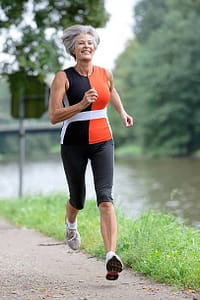
I know what some of you are thinking: I run marathons. I don’t need to sprint. My events are about endurance, not speed.
I thought the same thing. Here’s why I was wrong.
When you train exclusively at marathon pace or slower — which many of us do — your body becomes extraordinarily efficient at exactly that demand. Which sounds good. But efficiency means adaptation stops. You reach a ceiling in cardiovascular capacity, muscular strength, and metabolic flexibility.
Sprint intervals break that ceiling. They introduce a stimulus your body hasn’t experienced, forcing continued adaptation across multiple systems simultaneously. The result:
Your lactate threshold improves — meaning you can sustain harder efforts before accumulating the fatigue compounds that slow you down. Your running economy improves — meaning your marathon pace becomes less expensive, physiologically speaking. Your neuromuscular coordination sharpens — your stride becomes more powerful and efficient, not just through your legs but through your entire kinetic chain.
I’ve noticed this directly. After incorporating sprint sessions — hill sprints initially, then flat intervals — my marathon pace started feeling more manageable at the same heart rate. My late-race legs had more left. And my race recovery was faster, not slower.
How I Do Sprint Training as a Perimenopausal Runner: The Practical Protocol
This is the part where I give you the “pratico-pratique” breakdown — because theory without application is just interesting reading.
Start with hills. Hill sprints reduce impact stress on joints while delivering the same cardiovascular and muscular stimulus as flat sprints. This is especially important if you’re managing any joint sensitivity, which many of us are as estrogen — which has anti-inflammatory properties — declines.
Keep initial efforts short. My first sprint sessions were 8–10 seconds of maximal effort. That’s it. Full recovery between reps. I built gradually over several months. There is no trophy for going too hard too fast and getting injured.
Limit frequency. One to two sprint sessions per week is the appropriate volume for most recreational marathon runners. I do not sprint when I’m fatigued from a long run or a hard workout. The risk-reward ratio doesn’t support it.
Warm up properly. A perimenopausal body needs more preparation to perform at high intensity. I never go into a sprint session cold. At minimum: 15–20 minutes of easy jogging, dynamic mobility work, and strides before any true sprint effort.
Recover intentionally. Sprint sessions create more systemic fatigue than easy runs. The day after a sprint workout is an easy movement day — a walk, slow jog, or mobility work. Protein intake on sprint days should be a priority. Sleep is non-negotiable.
Track your response. I use my Garmin to monitor heart rate variability and resting heart rate trends. During hormonal flux — mid-cycle or during a particularly symptomatic perimenopausal phase — I will downgrade a sprint session to strides or skip it entirely. Listening to your body is not weakness. It’s intelligence.
A Note on Managing Perimenopausal Symptoms Around Sprint Sessions
Hot flashes, disrupted sleep, elevated cortisol, and hormonal volatility are all real factors that affect training readiness. I want to acknowledge this plainly because too many training plans ignore it entirely.
On days when symptoms are significant — poor sleep the night before, unusual fatigue, mood dysregulation — do not sprint. The physiological cost is too high and the recovery will be compromised. An easy Zone 2 run or rest is the smarter choice.
On days when you feel good — and there will be those days — sprint. This is where the gains happen. Training has to be responsive, not rigid.
The Bottom Line on Sprint Training for Women Over 50
Sprint training is not about becoming a different kind of athlete. It’s about becoming a more complete one.
For those of us running marathons and ultras past 50, navigating perimenopause, managing the cascade of physiological changes that come with this life phase — sprinting is one of the highest-leverage interventions available. It raises VO2 max (your longevity biomarker). It preserves fast-twitch muscle. It stimulates bone remodeling. It improves insulin sensitivity and metabolic efficiency. And it makes your marathon pace feel easier.
Slow jogging remains my foundation — I’m not walking away from the Zone 2 philosophy that has kept my joints healthy and my aerobic base strong. But sprinting is now part of my training ecosystem, and the results speak for themselves.
We are not finished. We are not slowing down. We are just training smarter.
Lace up. Find a hill. Run like you mean it.