
Traveling as a midlife runner is no longer about squeezing in miles between sightseeing and late dinners.
At 45+, especially during perimenopause and menopause, travel changes the equation.
Sleep shifts.
Hydration becomes critical.
Recovery slows.
Hormones fluctuate.
And yet—you are still a runner.
Still training.
Still racing.
Still committed.
The difference now is strategy.
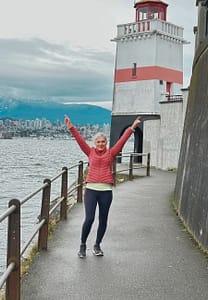
This trip to Vancouver was not just a change of scenery. It was confirmation that midlife travel as a runner is about intentionality—not intensity.
Let’s break down how to travel, train, fuel, and recover intelligently so your progress doesn’t stall every time you board a plane.
Why Travel Hits Midlife Women Harder
After 40, physiological resilience shifts.
Estrogen decline influences:
- Thermoregulation
- Sleep quality
- Muscle repair
- Cortisol regulation
Research in Frontiers in Physiology confirms estrogen’s role in muscle recovery and metabolic regulation.
https://www.frontiersin.org/articles/10.3389/fphys.2020.00963/full
Add travel stress—time zones, dehydration, disrupted sleep—and recovery becomes more fragile.
For a 30-year-old runner, one poor night of sleep may be manageable.
For a 50-year-old runner in perimenopause?
It can derail three days of training.
That’s why traveling as a midlife runner demands structure.
The 7 Strategies That Keep You in the Game
1️⃣ Protect Sleep Like It’s a Training Session
Travel disrupts circadian rhythm.
Menopause already reduces deep sleep stages.
Sleep deprivation increases cortisol, inflammation, and insulin resistance (Endocrine Reviews).
https://academic.oup.com/edrv/article/21/1/55/2531319
Before travel:
- Adjust sleep gradually if crossing time zones
- Pack magnesium glycinate (if approved by your doctor)
- Use eye masks + earplugs
Upon arrival:
- Get morning sunlight exposure
- Avoid late heavy meals
- Keep room cool (thermoregulation shifts during menopause)
Sleep is not passive. It is recovery infrastructure.
2️⃣ Hydration Is Not Optional
Estrogen influences fluid balance.
During menopause:
- Thirst response may blunt
- Hot flashes increase fluid loss
Travel (especially flights) causes mild dehydration.
Dehydration of even 1–2% body weight impairs performance.
American College of Sports Medicine recommends consistent hydration during travel.
https://www.acsm.org/docs/default-source/files-for-resource-library/exercise-and-fluid-replacement.pdf
Practical plan:
- Drink 16–20 oz water before boarding
- Add electrolytes
- Limit alcohol in-flight
Hydration protects joints, circulation, and recovery.
3️⃣ Replace One Hard Run with Aerobic Maintenance
When traveling, your goal is maintenance—not peak progression.
Zone 2 runs preserve aerobic base without overwhelming recovery capacity.
If sleep is poor:
Swap hard tempo workouts for:
- 30–45 minutes easy Zone 2
- Or a brisk walk in new surroundings
Consistency beats intensity.
4️⃣ Use Travel as Low-Impact Volume
Walking cities can accumulate 15,000–20,000 steps daily.
That is training stimulus.
Instead of forcing extra mileage:
- Count steps as aerobic volume
- Adjust formal run length accordingly
Midlife connective tissue appreciates lower impact days.
5️⃣ Fuel Strategically While Traveling
Nutrition becomes critical during travel.
Menopause reduces insulin sensitivity.
Airports are full of:
- Ultra-processed snacks
- High sugar foods
- Low protein options
Strategy:
✔ Pack protein bars or shakes
✔ Prioritize protein at meals
✔ Time carbohydrates around runs
✔ Avoid skipping meals
Research in The Journal of the International Society of Sports Nutrition recommends 1.2–1.6 g/kg protein for active older adults.
https://jissn.biomedcentral.com/articles/10.1186/s12970-017-0189-4
At 53, I learned:
If I skip protein while traveling, I pay for it in recovery.
6️⃣ Strength Training on the Road
Midlife runners must strength train to preserve:
- Muscle mass
- Bone density
- Running economy
Hotel workout circuit:
3 rounds:
- 12 bodyweight squats
- 10 lunges each leg
- 12 glute bridges
- 10 push-ups
- 30-second plank
Total time: 20 minutes.
This prevents regression during travel weeks.
National Institute on Aging supports resistance training for bone and muscle preservation.
https://www.nia.nih.gov/health/strength-training
7️⃣ Manage Stress Intentionally
Travel is exciting—but physiologically stressful.
Cortisol elevation impairs recovery.
Add in:
- Hormonal fluctuations
- Family logistics
- Time pressure
And stress multiplies.
Midlife runners must:
- Schedule downtime
- Avoid overscheduling
- Accept one less activity
Energy is not infinite.
It is managed.
The Vancouver Lesson

In Vancouver, I noticed something:
I no longer chase travel like I did at 35.
I wake early for a quiet run along the water.
I hydrate before coffee.
I eat protein before sightseeing.
I rest without guilt.
I still run.
I still explore.
But I pace.
That is maturity—not decline.
Pros and Cons of Running While Traveling
Pros
✔ Maintains aerobic base
✔ Reduces jet lag
✔ Regulates mood
✔ Preserves identity
✔ Supports metabolism
Cons
⚠ Increased injury risk if fatigued
⚠ Elevated cortisol if overtraining
⚠ Poor fueling access
Strategy neutralizes the cons.
For Beginners Traveling at Midlife
If you are new to running:
Travel weeks are not for progression.
Use:
- Walk-run intervals
- 20–30 minute easy efforts
- Mobility sessions
Build consistency first.
For Seasoned Runners (Like Me at 53)
Travel weeks require:
- Reduced volume
- Maintained frequency
- Increased protein
- Aggressive hydration
- Sleep discipline
This keeps races on track.
The Psychological Shift of Midlife Travel
At 50+, you no longer prove.
You protect.
You protect energy.
You protect recovery.
You protect long-term performance.
Travel becomes integrated—not disruptive.
Final Thoughts
Traveling as a midlife runner is not about perfection.
It is about adaptation.
You can:
- Maintain aerobic fitness
- Protect hormonal balance
- Preserve muscle
- Fuel intelligently
- Stay race-ready
But only if you approach travel strategically.
At 53, I do not chase miles recklessly.
I build durability—even on the road.
Because staying in the game is not about pushing harder.
It is about training smarter.