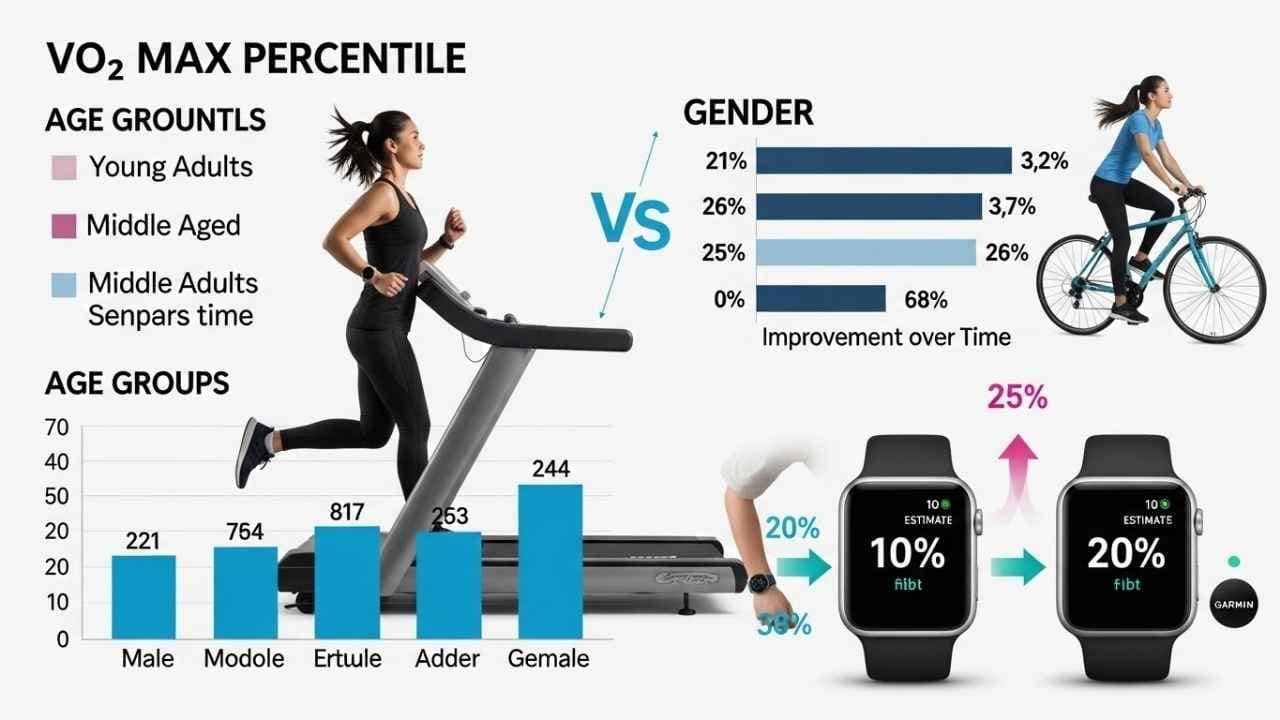
VO2 max longevity: The Powerful Runner’s Guide to Thriving Past 50
VO2 max longevity isn’t a catchy wellness phrase—it’s a measurable marker of how well your heart, lungs, blood vessels, and working muscles deliver and use oxygen under stress. And that “whole-system” capacity matters a lot once you’re past 50, especially if you’re a runner who wants to keep racing through perimenopause, menopause, and beyond.
Large cohort studies and clinical reviews consistently show that higher cardiorespiratory fitness (CRF)—often estimated via METs on a treadmill test and closely related to VO2 max—is strongly associated with lower all-cause mortality. In a huge cohort of over 120,000 people undergoing treadmill testing, higher fitness was linked to lower mortality, with no clear “upper limit” where benefit stopped. (JAMA Network) Clinical summaries also report that each 1-MET higher CRF (roughly 3.5 ml/kg/min VO2 max) is associated with about a 13% lower risk of all-cause mortality. (Mayo Clinic Proceedings)
So if you’re training because you love running—great. But if you’re training because you want your 60s, 70s, and 80s to feel strong, mobile, and independent, VO2 max longevity belongs on your short list of priorities.
This guide will explain:
- what VO2 max is (and what it isn’t),
- how percentiles work (so your watch estimate doesn’t mess with your head),
- the science connecting fitness to longer life,
- and a practical, runner-friendly training approach for boosting VO2 max after 50—without burning out.
What VO2 max really measures (in runner terms)
VO2 max is your maximal rate of oxygen consumption during hard exercise, typically expressed as ml/kg/min. Think of it as the size of your aerobic engine.
It is influenced by:
- cardiac output (how much blood your heart pumps),
- blood oxygen-carrying capacity (hemoglobin),
- capillaries and mitochondrial density in muscle (your “oxygen-using machinery”),
- and economy (how efficiently you move at a given pace).
Your VO2 max number is not your worth as an athlete. But for VO2 max longevity, it’s meaningful because it’s a proxy for how much “reserve” you have when life demands more: illness, surgery, stress, travel, hills, heat, or simply aging.
Professional organizations like the American College of Sports Medicine describe CRF as a core health component tied to chronic disease risk. (ACSM)
Why this matters more after 50
VO2 max tends to decline with age. Some of that is biology (lower max heart rate, reduced stroke volume), and some is lifestyle (less high-end intensity, less muscle, more sedentary time). If you keep training, you can slow that decline and often improve relative to peers.
Here’s the key idea: VO2 max longevity isn’t about becoming an elite athlete at 55. It’s about increasing your “physiological ceiling” so everyday tasks stay easy and your risk profile improves.
A review in Mayo Clinic Proceedings highlights the magnitude of the association between CRF and mortality and notes the approximate 13% lower all-cause mortality risk per 1-MET higher CRF in their summarized findings. (Mayo Clinic Proceedings)
Percentiles: how to interpret your number without spiraling
VO2 max percentiles compare you to people of the same sex and age group.
If you’re:
- 50th percentile: you’re around average for your group
- 75th percentile: better than ~75% of your group
- 90th+ percentile: you’re in rare territory (and usually training consistently)
A very practical reference point comes from the JAMA Network Open cohort paper’s fitness classification table (reported in METs by age and sex). For women 50–59, “above average” is listed around 8.1–9.9 METs, which roughly corresponds to 28–35 ml/kg/min VO2 max (multiply METs by 3.5 to estimate ml/kg/min). (JAMA Network)
Two important caveats for runners using watches
- Wearable VO2 max is an estimate, not a lab measurement. It can swing based on temperature, fatigue, hydration, hills, and whether you ran with a stroller into the wind.
- Some runners “look worse” on a relative ml/kg/min scale if body weight changes (because weight is in the denominator). Your fitness can improve while the number appears stubborn.
For VO2 max longevity, trends matter more than any single reading.
The science link between fitness and living longer
Let’s keep this clean and evidence-forward.
1) Higher fitness is associated with lower mortality
- In the large Cleveland Clinic/JAMA Network Open cohort (treadmill-tested), higher CRF was associated with lower all-cause mortality, and extremely high fitness was not associated with harm in that dataset. (JAMA Network)
2) Small improvements have meaningful impact
- An American Heart Association paper (classic treadmill cohort) reported an adjusted risk reduction of about 13% per 1-MET increase in exercise capacity. (AHA Journals)
- The Mayo Clinic Proceedings analysis similarly highlights the 1-MET → ~13% lower mortality association. (Mayo Clinic Proceedings)
- Sports medicine summaries also reference meta-analytic findings that a 1-MET higher CRF is associated with about 13% lower all-cause mortality risk and ~15% lower cardiovascular event risk. (British Journal of Sports Medicine)
This is why VO2 max longevity is such a strong “bang for buck” metric: improvements that feel modest in training terms can be meaningful in health terms.
3) Fitness can offset risk from other factors
Recent meta-analysis work also examines CRF together with BMI and mortality, reinforcing that CRF is a major independent predictor in risk profiles. (British Journal of Sports Medicine)
Translation: being fit doesn’t make you immortal, but it can move your risk needle in a big way.
How to measure VO2 max (from most accurate to most practical)
If VO2 max longevity is your goal, measurement should be helpful—not obsessive.
Option A: Lab VO2 max test (gold standard)
A cardiopulmonary exercise test (CPET) directly measures oxygen uptake. Best accuracy, higher cost, less accessible.
Option B: Treadmill test with METs (clinically common)
Many clinics report peak METs. METs convert to VO2 by multiplying by 3.5. This is a very useful health marker and is the basis for many mortality association studies. (JAMA Network)
Option C: Wearable estimate (most accessible)
Great for trends. Don’t treat it like a lab result.
Practical tip: pick one method and stick with it for comparisons.
The runner’s reality after 50: why VO2 max work has to be smarter
If you’re a midlife runner, especially perimenopausal or postmenopausal, you may notice:
- slower recovery from intensity,
- more sleep disruption,
- higher injury sensitivity (tendons, hamstrings, plantar fascia),
- and mood variability.
That doesn’t mean you stop training hard—it means you program it with more respect for recovery.
The best VO2 max longevity approach for most runners over 50 is not “more intensity.” It’s the right intensity, placed well, supported by strength, and fueled properly.
The training framework that builds VO2 max safely
To improve VO2 max longevity, you need two things:
- a big aerobic base (so you can absorb training),
- periodic high-end stimuli (so the ceiling rises).
A simple structure that works for many 50+ runners:
- 3–4 easy runs/week (mostly conversational effort)
- 1 quality session/week (true VO2 max / high aerobic stimulus)
- 1 long run/week (easy-moderate, primarily aerobic)
- 2 strength sessions/week (protect muscle, improve economy, reduce injury risk)
- 1 full rest day (non-negotiable if you’re adding intensity)
What counts as a “VO2 max” session?
A classic is intervals that put you near your max aerobic power, such as:
- 4–6 x 3 minutes hard / 3 minutes easy
- 5 x 2 minutes hard / 2 minutes easy
- hill repeats (short, strong efforts with full recovery)
You should finish feeling “worked” but not wrecked.
A practical 8-week plan to boost VO2 max (runner-friendly)
This is written for a healthy runner with a base of easy running. If you have cardiac risk factors, new symptoms, or are returning after illness, get medical guidance first.
Weeks 1–2 (build tolerance)
- 1 session: 8 x 1 minute hard / 1 minute easy
- Long run: easy
- Strength: 2 sessions (hips, calves, hamstrings, core)
Weeks 3–4 (build the engine)
- 1 session: 5 x 2 minutes hard / 2 minutes easy
- Add 6–8 relaxed strides after 1–2 easy runs (optional)
- Long run: easy with a short steady finish if you feel good
Weeks 5–6 (raise the ceiling)
- 1 session: 5 x 3 minutes hard / 3 minutes easy
- Long run: easy
- Keep strength consistent
Weeks 7–8 (consolidate + retest)
- 1 session: 4 x 3 minutes hard / 3 minutes easy (slightly reduced volume)
- Optional: a 20-minute steady run (comfortably hard) on another day
- Retest: wearable estimate trend, or a repeatable field test (same course, same conditions)
Why this works: you’re giving the body enough high-intensity exposure to stimulate VO2 max adaptations without piling on fatigue that wrecks consistency—the real driver of VO2 max longevity.
Strength training: the missing piece for many endurance athletes
Strength training won’t magically spike VO2 max overnight, but it:
- protects muscle as you age,
- supports running economy,
- reduces injury risk,
- and helps you handle VO2 max sessions without falling apart.
Two simple weekly lifts for runners:
- Lower body: squat pattern + hinge pattern + calf raises
- Upper body: row + press + carry
- Core: anti-rotation + anti-extension
Keep it boring. Keep it consistent. Your running will feel better.
Fueling for VO2 max gains (especially after 50)
Under-fueling is one of the fastest ways to sabotage VO2 max longevity because it increases stress load and slows recovery.
Minimum effective rules:
- Eat protein at every meal.
- Fuel your hard workout day like it matters (carbs before/after).
- Don’t “earn” your dinner by doing intervals on fumes.
If sleep is fragile, prioritize stable daytime fueling to reduce late-night hunger spikes.
A realistic case study (midlife runner)
A 53-year-old marathoner notices her watch VO2 max slipping during perimenopause. She’s training hard but feels:
- more fatigue after intervals,
- more irritability,
- and slower bounce-back.
She changes:
- intensity from 2 sessions/week to 1,
- adds strength twice weekly,
- protects sleep (cool room, consistent bedtime),
- fuels intervals with carbs and recovers with protein.
After 10 weeks:
- her VO2 max estimate rises,
- her easy pace feels easier again,
- and she completes a 10K feeling controlled—not crushed.
That’s the signature of a good VO2 max longevity plan: fewer heroic days, more strong months.
What “good VO2 max” looks like after 50 (without perfectionism)
Instead of obsessing over elite numbers, anchor to this:
- Can you keep improving or maintaining relative to peers?
- Can you climb stairs, travel, and run comfortably without feeling “maxed out” all the time?
- Can you train consistently without recurring injuries?
The most protective thing for VO2 max longevity isn’t chasing a single number—it’s building a lifestyle where aerobic training stays sustainable.
Bottom line
VO2 max longevity is a powerful lever because it reflects whole-body function and is strongly associated with survival and long-term health in large datasets. (JAMA Network)
The good news: you can improve it after 50 with a simple formula:
- mostly easy running,
- one well-placed hard session weekly,
- strength training,
- and recovery that’s treated like training.
If you want to keep running and racing past 50, this is the work that pays you back for decades.